

Do We Really Want Australian Made... Or Just The Idea Of It?

Notes From The Sidelines • July 29, 2026

We all scream "shop local" but how much do WE actually do it?

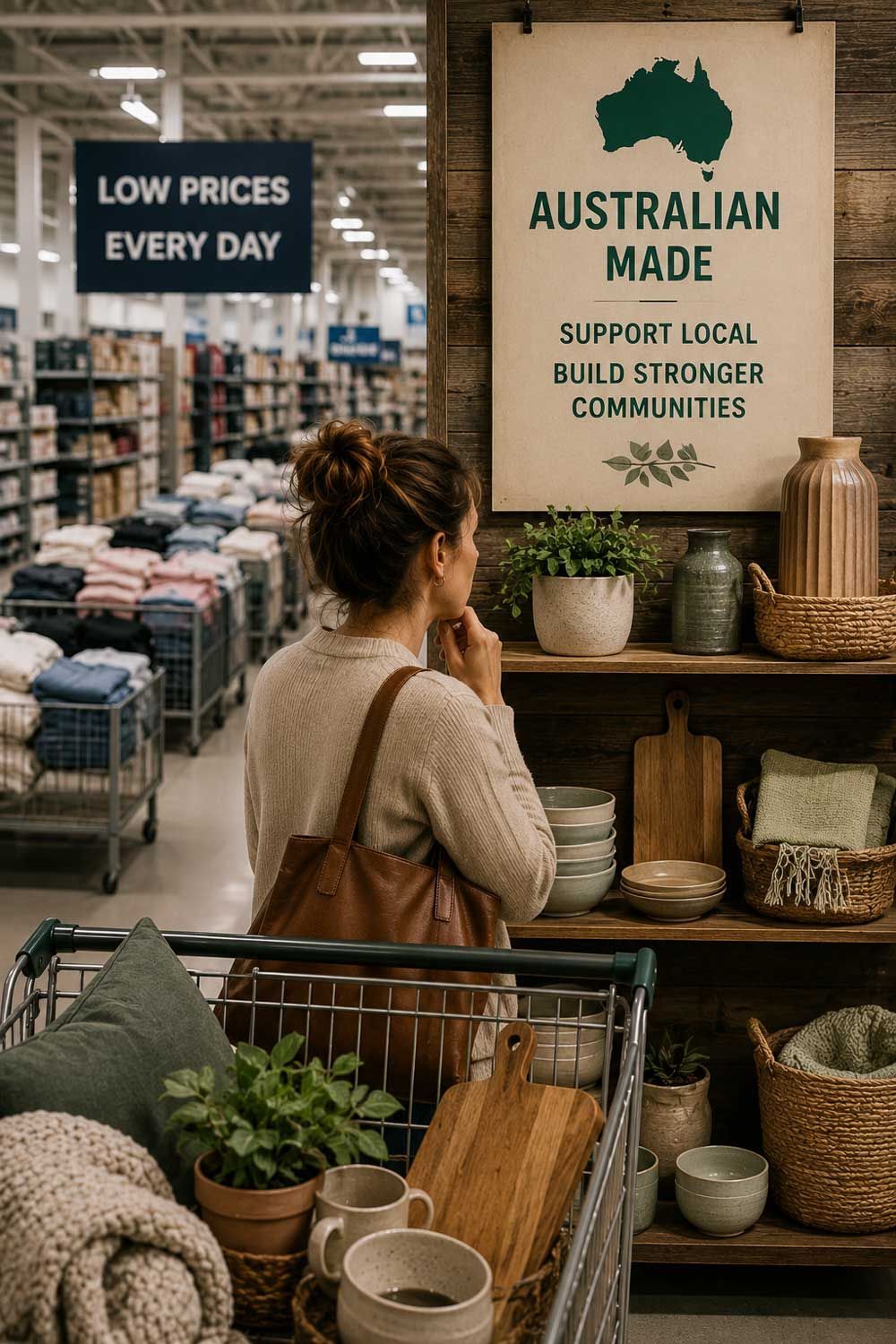
A woman considering purchasing from a store with Australian made products or from a big retailer with imported goods.

Walk through almost any Australian shopping centre and you'll find no shortage of people who proudly say they support Australian businesses.


When natural disasters strike, we rally behind local producers. When factories close, we talk about the importance of Australian manufacturing. We celebrate businesses that still make products here and we worry about jobs disappearing overseas.


We genuinely seem to value the idea of Australian made.


Then Saturday arrives.


We fill our trolleys with imported homewares, inexpensive clothing, cheap furniture and products designed to be replaced rather than repaired. We search online for the lowest price, celebrate a bargain and often buy things we didn't even know we wanted five minutes earlier.


This isn't about judging anyone. Most Australians are feeling the pressure of rising living costs, higher mortgage repayments and increasing household expenses.


But perhaps it's worth asking an uncomfortable question.


Do we really want Australian made products, or do we simply like the idea of them?


We All Want Australian Manufacturing


It's difficult to find anyone who openly argues against Australian manufacturing.


We like the idea of local jobs. We like supporting family businesses. We appreciate craftsmanship and quality. We understand that local manufacturing creates stronger communities, more resilient supply chains and skilled employment opportunities.


Most Australians would probably agree that we'd rather see a factory open than close.


So on paper, we're all on the same side.


The challenge begins when we look at the price tag.


Until We See The Price Tag


Imagine you're shopping for a new chopping board.


One is made in Australia using locally sourced timber. It costs $45.

The other was manufactured overseas. It looks similar and costs $15.


The same decision plays out with clothing, furniture, cookware, home décor and countless everyday items.


When household budgets are stretched, it's completely understandable why many people choose the less expensive option.


For some families, it isn't really a choice at all.


Cost of living pressures are real and nobody should pretend otherwise. But perhaps price isn't the only factor influencing our decisions. Maybe we've also changed the way we think about buying things.

Have We Become Addicted To Cheap?


Over the past twenty years, shopping has changed dramatically.


Retailers have become incredibly good at convincing us that low prices are victories.


  • If something costs less, buying it feels smart.
  • If there's a sale, buying two feels even smarter.
  • If it's inexpensive enough, we often convince ourselves we may as well buy it because "you never know."


Somewhere along the way, shopping stopped being about replacing what we needed.

It became entertainment.


We browse for things rather than search for them.


We purchase because something is inexpensive rather than because it solves a problem.


And when products become cheap enough, owning more starts to feel normal.


Is More Replacing Better?


Think about the average Australian home today.


  • Many of us own more clothing than we regularly wear.
  • More kitchen gadgets than we regularly use.
  • More decorative items than we really notice.
  • More furniture than earlier generations would probably have considered necessary.


Twenty or thirty years ago, people often saved for quality. A lounge suite might stay in the family for fifteen years. A solid timber dining table became something that moved from one home to another. Shoes were repaired instead of replaced.


Today, we often replace perfectly functional items simply because something newer or trendier has appeared.


The problem isn't that we have choices.


The problem is that we may have started confusing quantity with value.

The Hidden Cost Of Cheap


A lower price doesn't always mean a lower cost. A shirt that loses its shape after six months. A bookshelf that wobbles after one move. A kitchen appliance that can't be repaired because replacing it is cheaper.


These products often end up in landfill long before they should.


Then there are the hidden environmental costs.


  • Shipping products around the world.
  • Excess packaging.
  • Disposable manufacturing.
  • Constant replacement.


The cheapest option at the checkout isn't always the cheapest option over time. Sometimes buying twice costs far more than buying once.


Could We Afford Australian If We Bought Less?


This might be the most uncomfortable question of all.


What if supporting Australian manufacturing isn't simply about spending more? What if it's about buying less?


Imagine someone purchases ten inexpensive shirts each year because they're always on sale. Now compare that with someone who buys three higher-quality Australian made shirts that last several years. The upfront cost may be higher. The long-term cost may not be.


The same applies to furniture, cookware, outdoor equipment and countless other products. This isn't an argument that everyone can suddenly afford to buy Australian. For many households, that's simply unrealistic. But perhaps some of us could buy Australian more often if we stopped buying so much of everything else.


Supporting Local Is About More Than Patriotism


Buying Australian isn't just about waving a flag.


  • It's about keeping skills alive.
  • It's about apprentices learning trades.
  • It's about regional towns having secure employment.
  • It's about small businesses employing local families instead of profits disappearing offshore.


Once manufacturing knowledge disappears, rebuilding it is incredibly difficult. Factories don't reopen overnight. Trades aren't relearned in a few months. Communities don't quickly recover from losing industries that supported them for decades.


Every local purchase contributes, even if it feels small.

Maybe The Goal Isn't Perfection


Let's be realistic.


Very few Australians can afford to buy every product made locally. Nor should anyone feel guilty for making choices that fit within their budget. The goal doesn't have to be perfection. Perhaps it's simply about becoming more intentional.


  • Buying fewer things.
  • Choosing quality when we can.
  • Repairing instead of replacing.
  • Supporting local businesses when the opportunity presents itself.


Asking ourselves one simple question before making another purchase.


Do I actually need this?


Sometimes the most sustainable purchase is the one we never make.


Our Wallets Vote Every Day


It's easy to tell people we support Australian manufacturing. It's much harder when we're standing in front of two price tags. One costs significantly less. The other represents local jobs, local skills and products designed to last.


Neither choice is always easy.


For many Australians, affordability will continue to shape purchasing decisions, and that's a reality that can't be ignored. But perhaps we've reached a point where we need to ask ourselves a different question. Have rising prices made Australian made products impossible to support?


Or has our growing appetite for more, newer and cheaper products changed the way we define value?


Every purchase we make is a vote.


Not just for the product we take home, but for the kind of economy, communities and future we want to build. Maybe supporting Australian manufacturing isn't about buying everything locally. Maybe it's about buying with greater consideration.


Owning fewer things. Choosing better things.


And recognising that sometimes the cheapest option costs us far more than we ever see on the price tag.


Notes From The Sidelines

Share this article

Recent Posts

A man frustrated with bad customer service.
By Notes From The Sidelines June 22, 2026
Has technology improved customer service or simply made it cheaper for businesses? Explore chatbots, self-service systems, offshore support and the value of speaking to a real person.
A smartphone sitting on a kitchen bench
By Notes From The Sidelines June 22, 2026
Smartphones have made life easier, but have they also reduced our curiosity, creativity and willingness to experience the world firsthand?
A couple sit at a cafe having a conversation
By Notes From The Sidelines June 22, 2026
Have we forgotten how to disagree? Explore whether modern society has started viewing debate as confrontation, why differing opinions feel more personal than ever, and what we may have lost along the way.
A young couple inspect an apartment they are hoping to purchase
By Notes From The Sidelines June 22, 2026
Have we made it impossible for our children to be grown up? Or is adulthood entirely different than it was just one generation ago?
An employee and his supervisor chatting in a manufacturing workshop.
By Notes From The Sidelines June 22, 2026
Have workplace protections gone too far, or are employers simply avoiding difficult conversations? We explore the challenges of performance management, accountability and fairness in modern Australian workplaces.

A man and a pregnant woman sitting on a park bench talking.
By Jenny Marsden June 22, 2026
Modern sexual freedom has transformed society, but pregnancy can still change lives forever. Explore the difficult questions around choice, responsibility, child support and reproductive rights.

A woman walking along a riverside path.
By Jenny Marsden June 22, 2026
Healing is supposed to feel like freedom, so why does it sometimes feel like betrayal? Exploring grief, recovery and the guilt that can come with moving forward.

A man sits on a bench by the ocean contemplating his loss.
By Notes From The Sideline June 22, 2026
If grief is the currency of loss, how much do we need to spend? Questioning whether suffering is always necessary to honor the people we love.
An employer frustrated over not being able to get people to just do their jobs.
By Notes From The Sidelines June 22, 2026
Is it getting impossible for employers to just ask people to do their jobs?