How Many Ways Has Technology Made Customer Service Worse?

Notes From The Sidelines • June 22, 2026

Technology Has Overtaken People In Ways That Are NOT Helping

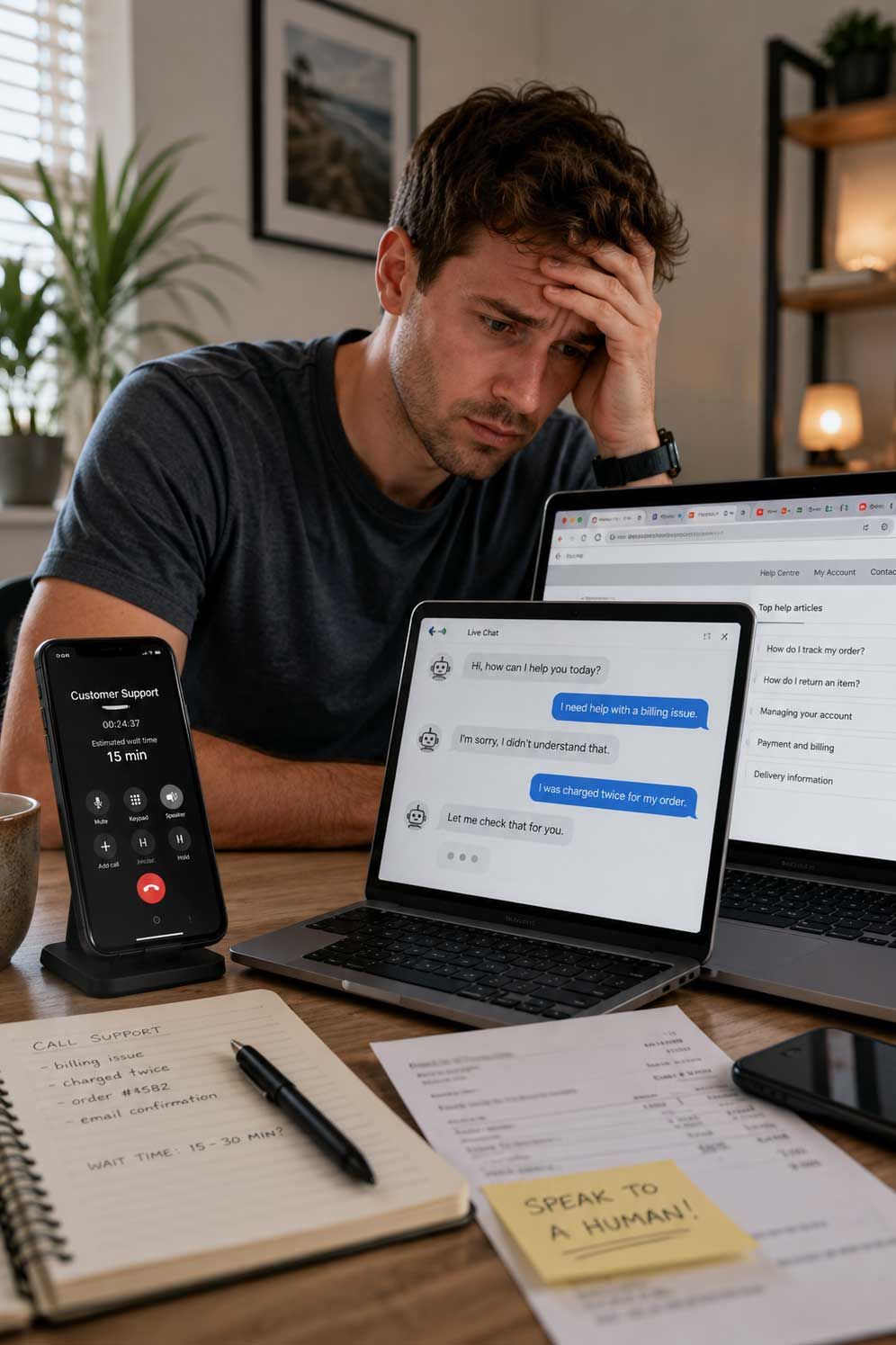
A man frustrated with bad customer service

Technology has transformed almost every aspect of modern life. We can order groceries without leaving the couch, transfer money instantly, book holidays in minutes and have products delivered to our door faster than ever before. By almost any measure, technology has made life more convenient.


Yet mention the words "customer service" in almost any social gathering and the stories start flowing.


The chatbot that couldn't answer a simple question. The phone menu that seemed designed to trap you in an endless loop. The company that insisted you visit a website to solve a problem that only existed because the website wasn't working in the first place.


For all the convenience technology has brought, many customers feel that service itself has quietly gone backwards. The question is whether technology has genuinely made customer service worse, or whether it has simply exposed a growing tension between what businesses call efficiency and what customers call support.


Let Me Tell You A Customer Service Horror Story


We, like many others, had flights cancelled during COVID. Some airlines (hi Qantas!) gave me the option of a full refund which I greatly appreciated, but most gave me a flight credit. I get it - airlines are businesses too and we wouldn't have had any left if they could offer people future credits instead of full refunds.


After a few years when I went to use my flight credits with Air Asia it was an absolute nightmare. I have no trouble naming and shaming in this case because I KNOW I went as far as I possibly could to work it out with them but it just wasn't possible.


When I went to use my credit, for some reason it was only applying a tiny amount of the credit. I had the equivalent of around $2000 AUD to use but to start, every flight I tried to use it on would give me a "credit use isn't available on this flight" or something similar. I can't remember the exact working but that was the gist of it.


Then I worked out that it wasn't letting me use the credit for the "business class" fare. It would only seem to let me use it on the economy seats. Now, apart from that being what I would consider illegal (not sure if it actually is) the credit came from business class seats. For those who aren't Australian, it takes months to get anywhere from Australia. Well maybe not months but its not a simple "fly to London" type situation.


Air Asia business class is FAR from actual business class but you do get a lay flat seat which for those overnight flights where I can't sleep anyway, are almost essential for me.


So unless I get them on points, I never pay for business class with another airline. I just don't have that kind of money, but Air Asia offer a business class service without any frills for a kind of reasonable price.


After I realised what was happening I got on Air Asia's website and started chatting with their bot. OMFG! Unless you are trying to just get the details of your flight there is absolutely no way you can resolve anything. There are set options, clearly set responses from the bot and unbeknown to me at this time, NO ACTUAL PEOPLE IN THEIR CUSTOMER SERVICE DEPARTMENT AT ALL.


I spent hours trying to work my way through different choices to get to the point where I even got the possibility of a follow up email but nope. I never got anywhere.


So, I just walked away from trying to book the flights. I was just done.


A few months later I tried again but this time, I could only apply the credit to the flight component of the price. So where I had paid over $2k for a ticket that was inclusive of fees, fuel levy's, airport tax and all the other crap that goes with an airline purchase, this time that credit was ONLY allowed to be used on the flight component. Again WTAF???


So back I go to Ava or whatever her name is. Another 4 hours of my time disappears. My cardio vascular system seems irreparably damaged from the stress of it all and again no chance of resolution.


In the end I decided to go to the Ombudsman. Oh - it turn out Australia doesn't have an Aviation Ombudsman. Airlines can just offer little or no customer service and that's fine with the Australian government. I can't seem to ask someone to actually do their job because of our red tape I face as a business owner, but international airlines can operate with no recourse whatsoever.


In my mind, a bot that gives you only choices they want you to make, even if you do name her IS NOT CUSTOMER SERVICE.


Customer Service Used To Be A Person


Not that long ago, customer service usually meant speaking to another human being. If something went wrong, you visited a local branch, picked up the phone or walked into a store. You explained the issue and, more often than not, someone tried to solve it.


Were those systems perfect? Certainly not.


You might have waited in line. You might have been transferred to a manager. But there was usually a person involved who could understand context, exercise judgement and occasionally bend the rules when common sense demanded it.


Today, many businesses have removed those layers of human interaction altogether. Reception desks have disappeared. Local branches have closed. Phone numbers are hidden behind websites. Human contact is increasingly treated as a last resort rather than the starting point.


In many cases, customers don't feel like they are dealing with people anymore. They feel like they are dealing with systems. And for the most part,these systems do not work!


When Did Customers Become Unpaid Employees?


One of the biggest changes in customer service has been the rise of self-service.


  • We check ourselves out at supermarkets.
  • We book our own appointments.
  • We process our own returns.
  • We update our own account details and troubleshoot our own problems.


Businesses often present this as a convenience. Sometimes it genuinely is. Few people miss waiting on hold simply to check an account balance or book a routine appointment.


But there is another side to the story.


Many tasks that were once handled by employees have gradually been transferred to customers. We now perform work that businesses previously paid staff to do, often without even noticing the shift. Imagine walking into a restaurant, cooking your own meal and then being told how efficient the process was. That sounds ridiculous.


Yet in many industries, customers have become active participants in the business operation itself.


The question is whether we're being empowered or simply doing unpaid labour.


The Endless Maze Of Phone Menus


Perhaps nothing symbolises modern customer service quite like the automated phone menu.

"Press 1 for billing."

"Press 2 for technical support."

"Press 3 to hear these options again."


By the time you've navigated six layers of options, entered your account number three times and listened to ten minutes of recorded messages, you may have forgotten why you called in the first place.


Technology was supposed to make communication easier.


Instead, many systems feel designed to filter customers before they reach an actual person. Businesses would argue these systems improve efficiency by directing enquiries to the correct department. Customers often suspect they exist to discourage contact altogether. The truth is probably somewhere in the middle.


Chatbots: Helpful Assistant Or Digital Roadblock?


Chatbots may be one of the most divisive innovations in customer service. At their best, they are genuinely useful. Need to reset a password? Check an order status? Find a simple piece of information? A chatbot can often solve the issue within seconds.


No waiting. No hold music. No frustration.


The problem arises when the issue isn't simple. Many customers have experienced the cycle of explaining a complex problem to a chatbot, receiving irrelevant responses and eventually asking for a human anyway. What should have taken two minutes often turns into twenty. This creates an uncomfortable question.


Are chatbots primarily designed to help customers, or are they designed to reduce the number of customers who reach expensive human support teams?


The answer may depend on which side of the conversation you're sitting.


The Rise Of "Computer Says No"


Another subtle shift has occurred within organisations themselves. Employees increasingly rely on systems, policies and software to make decisions. In many cases, frontline staff have very little authority to exercise judgement. A customer might be speaking to a real person, but that person is often bound by rules established by a system they cannot override.


The result is a phrase many customers have heard in one form or another: "I'm sorry, but the system won't allow me to do that."


Technology has created consistency, which can be valuable. It has also reduced flexibility. Sometimes customers don't want a policy. They want a solution. And solutions often require human judgement.


Have We Mistaken Cost Savings For Innovation?


One reason customer service generates so much frustration is that businesses often describe cost-cutting measures as innovations.


  • A new chatbot is announced as an improvement.
  • A reduced support team is presented as a streamlined process.
  • A self-service system is marketed as greater convenience.


Sometimes these claims are true. Sometimes they are simply clever packaging. Technology can absolutely improve customer service when it makes problems easier to solve. But not every technological change benefits the customer equally.


Some innovations primarily benefit the business. That's not necessarily wrong. Businesses need to remain profitable.

The problem arises when efficiency becomes the only measure of success. A system that saves money but frustrates customers may not be an improvement at all.


The Case For Technology


To be fair, few people genuinely want to return to the customer service systems of twenty years ago. Online banking is easier. Flight bookings are easier. Parcel tracking is easier. Many routine tasks that once required lengthy phone calls can now be completed in seconds.


Technology has eliminated countless frustrations. The challenge is not technology itself. The challenge is recognising that customer service is ultimately about people. No matter how sophisticated systems become, there will always be situations where customers need understanding, flexibility and human judgement.


Technology excels at handling routine problems. Humans remain surprisingly good at handling unusual ones.


Would You Pay A Small Fee To Speak To A Local Human?


Here's where things get controversial. What if businesses gave customers a choice? Imagine three support options:

  • Free chatbot support.
  • Free standard support with longer wait times.
  • Premium support where you pay a small fee to speak directly with a local, knowledgeable person.


Perhaps it costs two dollars. Maybe five. Maybe it is included as part of a membership.


At first glance, many people will object. After all, why should customers pay extra to receive decent service? It's a fair criticism. But consider how often people already pay for convenience.


We pay extra for express shipping. We pay extra for priority boarding. We pay extra for premium subscriptions. Time has value. For someone trying to solve an urgent issue, paying a few dollars to speak immediately with a skilled local operator may feel like excellent value.


The model could even help support local jobs that have steadily disappeared as customer service has moved offshore or become automated. Of course, it also risks creating a two-tier system where quality service becomes something only certain customers can afford.


That possibility should make us uncomfortable. Yet it raises an interesting question. If technology has made human service more expensive, is there a future where customers actively choose when human interaction is worth paying for?


When You're Speaking The Same Language But Not Really


One of the most sensitive aspects of modern customer service is also one that many people are hesitant to discuss openly.

As businesses have increasingly moved support centres overseas, customers often find themselves speaking to people who technically speak the same language but don't necessarily share the same cultural references, local knowledge or communication style.


This isn't a criticism of the people doing the job.


Most customer service representatives are working hard and doing their best within the systems they have been given. In many cases, they may be communicating in a second or third language, which is something many of us could never do ourselves.


The challenge is that communication is about far more than vocabulary.


Accents can make conversations difficult to follow, particularly when discussing technical issues, account details or complex problems. Local slang, regional expressions and industry-specific terminology can create additional confusion.


Australians are especially prone to this. We shorten words, invent nicknames and use phrases that often make perfect sense to other Australians but can sound completely foreign to someone on the other side of the world.


Likewise, support staff may use terminology, pronunciations or expressions that customers struggle to understand.

The result is frustration on both sides.


Customers become irritated because they feel they are not being understood. Support staff become frustrated because they are trying to help but are constantly being asked to repeat themselves.


In many cases, the actual problem isn't the product or service at all. The problem is communication.


This raises an uncomfortable question. Have businesses become so focused on reducing costs that they underestimate the value of clear, effortless communication?


Perhaps one of the reasons some customers would happily pay a small premium for local support isn't because they believe local staff are better. It may simply be because communication becomes easier when both people share the same language, culture, references and expectations.


Sometimes the fastest way to solve a problem isn't better technology. It's simply understanding each other the first time.


Faster, Cheaper, Better... Pick Two


Technology has undoubtedly made customer service faster and cheaper. Whether it has made it better is another question entirely.


Businesses have saved billions through automation, self-service platforms and digital support systems. Customers have gained convenience in many areas and frustration in others.


Perhaps the problem isn't that technology has made customer service worse. Perhaps the problem is that we've spent so much time asking what technology can do that we've forgotten to ask what customers actually want.


Because for all the advances in artificial intelligence, automation and digital platforms, most people still seem to want the same thing they've always wanted when something goes wrong: To speak to someone who understands the problem and can help fix it.


Or are we all missing the big picture here? Are products and services much more affordable these days because of things like cheaper customer service costs?


The technology may have changed.


The customer hasn't.


Join the conversation and have your say over on Medium


Notes From The Sidelines

Share this article

Recent Posts

A smartphone sitting on a kitchen bench
By Notes From The Sidelines June 22, 2026
Smartphones have made life easier, but have they also reduced our curiosity, creativity and willingness to experience the world firsthand?
A couple sit at a cafe having a conversation
By Notes From The Sidelines June 22, 2026
Have we forgotten how to disagree? Explore whether modern society has started viewing debate as confrontation, why differing opinions feel more personal than ever, and what we may have lost along the way.
A young couple inspect an apartment they are hoping to purchase
By Notes From The Sidelines June 22, 2026
Have we made it impossible for our children to be grown up? Or is adulthood entirely different than it was just one generation ago?
An employee and his supervisor chatting in a manufacturing workshop.
By Notes From The Sidelines June 22, 2026
Have workplace protections gone too far, or are employers simply avoiding difficult conversations? We explore the challenges of performance management, accountability and fairness in modern Australian workplaces.
A man and a pregnant woman sitting on a park bench talking.
By Jenny Marsden June 22, 2026
Modern sexual freedom has transformed society, but pregnancy can still change lives forever. Explore the difficult questions around choice, responsibility, child support and reproductive rights.
A woman walking along a riverside path.
By Jenny Marsden June 22, 2026
Healing is supposed to feel like freedom, so why does it sometimes feel like betrayal? Exploring grief, recovery and the guilt that can come with moving forward.
A man sits on a bench by the ocean contemplating his loss.
By Notes From The Sideline June 22, 2026
If grief is the currency of loss, how much do we need to spend? Questioning whether suffering is always necessary to honor the people we love.
An employer frustrated over not being able to get people to just do their jobs.
By Notes From The Sidelines June 22, 2026
Is it getting impossible for employers to just ask people to do their jobs?