Are We Working Harder For Less
Why Does A Decent Income No Longer Feel Like A Decent Income?
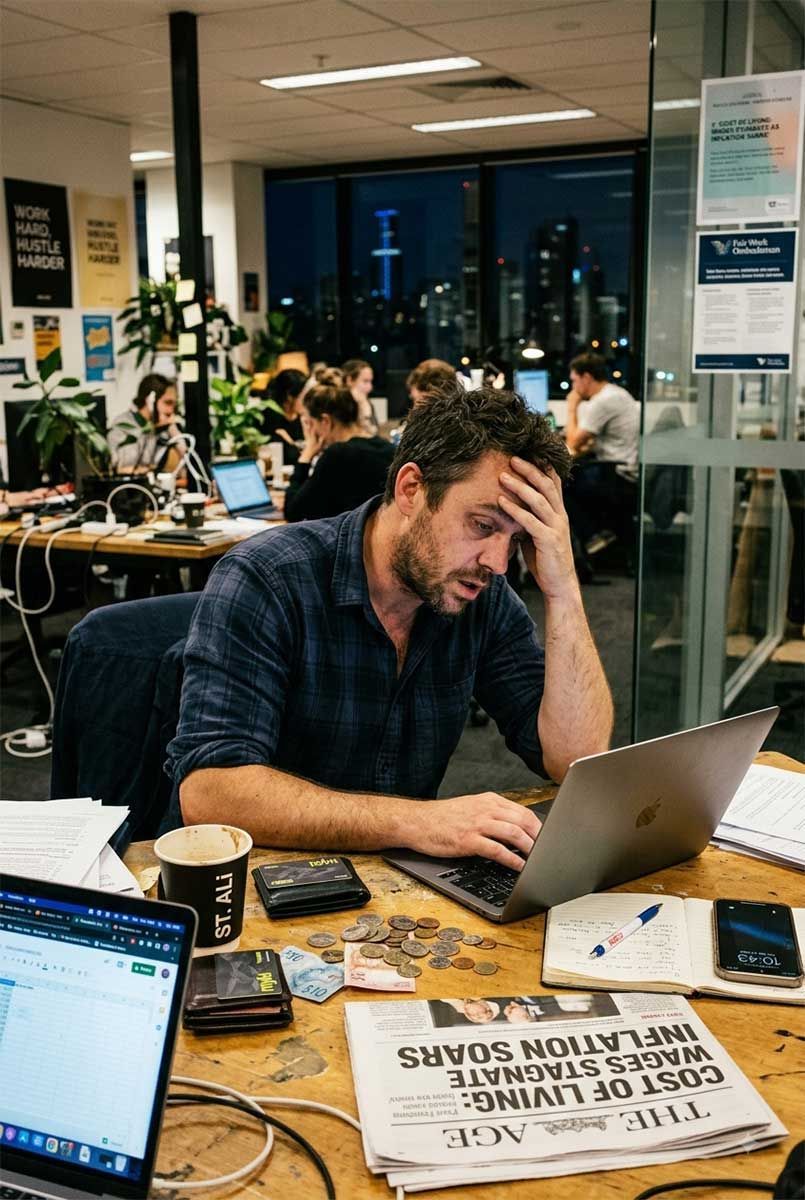
There is something strange happening with money in Australia.
You can have a good job, earn what would once have sounded like a very respectable salary, work full-time and still regularly wonder where all your money went.
The mortgage comes out.
Or the rent.
Then there are groceries, electricity, insurance, petrol, rates, childcare, school expenses and everything else required to keep a household running.
By the time they're all paid, that decent income suddenly doesn't feel particularly decent anymore.
It's easy to look back twenty or thirty years and conclude that previous generations simply had it easier.
In some important ways, they absolutely did.
But perhaps there is another part of the conversation that we're reluctant to have.
Has the cost of living increased, or has the cost of what we consider a normal life increased as well?
Maybe both are true.
What Did A Normal Australian Life Cost 20 Years Ago?
Comparing generations is difficult because we're rarely comparing exactly the same things. Housing is the obvious example.
For many Australians, the relationship between income and the cost of buying a home has changed enormously. Saving a deposit while paying rent can feel almost impossible, particularly in our major cities.
Then there are childcare costs, insurance, energy prices and the everyday expenses that seem to increase every time we look at them.
These pressures are real.
It would be ridiculous to tell a young Australian struggling to save for a house that their grandparents managed it, so they should simply try harder.
The numbers are different. But so is the lifestyle we're trying to fund. And that's where the comparison gets more complicated.
The Cost Of Living Has Increased, But So Has The Cost Of "Living"
Think about what an ordinary Australian household pays for today that barely existed twenty or thirty years ago.
- Multiple mobile phones.
- High-speed internet.
- Streaming services.
- Cloud storage.
- App subscriptions.
- Food delivery.
- Gym memberships.
- Regular takeaway coffees.
- Frequent technology upgrades.
For many households, overseas travel has moved from something extraordinary to something expected every year or two.
Eating out has become more common. Beauty and grooming routines have expanded. Children have phones, tablets, gaming subscriptions and extracurricular activities that all cost money.
None of these things individually explains Australia's cost of living problem. And cancelling Netflix certainly isn't going to magically produce a house deposit.
But collectively, they matter.
Perhaps one of the reasons a good income doesn't feel as substantial anymore is because we're asking it to pay for far more.
Lets Check Out Those "Necessary" Expenses We All Have
I remember when I was about 13. I think I was my first year in high school. I wanted a pair of Adidas shoes like I've probably wanted nothing else in my life since.
We weren't really struggling as a family, but my mum drank and smoked and didn't work, so Dad's income didn't go too far. We were technically middle class from the outside but from the inside I think probably closer to the poverty line that we wanted to believe. From choices that my parents made, but still there wasn't ever money for extras.
So me wanting a pair of Adidas shoes instead of the cheap Betts and Betts sandshoes just wasn't a realistic hope. Still, those shoes were so high on my list, I'm not entirely sure what I would have done for them, if the choice were given me.
Without a doubt "going without" multiple other items would certainly have been worth it. That's the phrase isn't it?
Going without!
80's Living Costs Vs Modern Day Living Costs
Sure some things are really out of the realm of affordability for many Australians these days but just how so? Lets look at items that the modern 30 year old Aussie does or has.
Streaming Services for TV, apps or some kind of digital membership can run to $200 per month if you add them all up. Can you do without them, absolutely.
We have great free to air streaming in Australia and if you can't find something to watch on SBS OnDemand, ABC iView or one of the other channel's services there is something wrong.
Mobile Phone plans and replacement. Phone plans are readily available and affordable, however without owning your phone outright that can be more difficult.
Do you really need to replace your iPhone every time a new model comes out though? No you do not. At the end of the day, unless you are 16, no-one cares what type of phone you have so why do you?
I have a friend who is a big traveler who came back into Australia a few years ago and upon landing got a message from Telstra that her phone was no longer supported. 6 years she had that phone and guess what?
It was still working just as well as when she had purchased it. Sadly, the technology changed pretty fast so her 3G phone was now outdated, but she travelled the world with that phone with no challenges at all.
You might think that your $179/month phone plan isn't too bad, but that's about $2200 per year assuming that $80 of that cost is paying off your phone, and assuming you replace your phone every 2 years (working on a modern iPhone or top of the range Android being $2200 ish).
A cheap phone plan can be around $30/month and a Motorola G67 or an Oppo G60 can be bought for around $260 AUD. These are both good phone brands so still modern in style and capabilities. Compare that to $1400 AUD for the base iPhone or $2300 for the top Samsung, and it just doesn't make sense!
Now add in hair extensions, monthly nail treatments, fashionable clothing, fuel, coffee, eating out and the "expenses" just spiral out of control.
Are We Actually Working Harder?
There is another part of the equation worth examining. Are we actually working harder?
For many people, the answer probably feels like yes.
- Modern work follows us everywhere.
- Emails arrive after dinner.
- Messages appear on weekends.
Our phones mean we can theoretically be contacted almost anywhere. Working from home has brought enormous flexibility, but it has also blurred the boundary between work and personal life.
For many Australian families, maintaining a comfortable household also requires two full-time incomes. Previous generations certainly worked hard, often in physically demanding jobs and sometimes under conditions we would rightly reject today.
But modern work has introduced a different kind of pressure.
Perhaps we're not necessarily working more hours. Maybe work simply occupies more of our mental space.
Housing Is The Elephant In The Room
Any discussion comparing today's financial pressures with previous generations has to acknowledge housing. A first-home buyer today faces a very different market from the one many of their parents entered.
The deposit alone can be enormous.
Rent consumes a significant portion of many people's income while they're simultaneously trying to save. I lived with a friend through university and then continued to do so after we both started working.
We shared a 2 bedroom, 1 bathroom unit in an OK area, but it was old and there was no AC or anything like that. We paid $74 per week for the apartment which included our power, which was around $37 each.
During Uni I earned about $75/week working 12 hours on a Friday pushing a wheelbarrow for a concrete company. So half of my pay went on rent and that was doable. I wasn't saving anything of course but I was also full time study so that was pretty decent.
Once we started working, my first salary was $28,000. I think I took home around $470 net each week. By this stage our rent had gone up to $105 per week (maybe 4 or 5 years later) so at $55 each still very affordable!
That sat at around 12% of my net income.
Researching for todays prices, a 2 bedroom 1 bathroom unit in most Aussie capital cities sits at around $700-$850 per week, which if sharing would put my share at $420ish. For the same role I was doing when I left uni I would get paid around $86,000 today. That would mean a take home pay of around $1280 AUD.
That would put my rent ratio at around 32% of my net income.
Is that really that unrealistic?
People are buying later, borrowing more and competing for homes in markets where prices can feel completely disconnected from ordinary wages.
This is why the tired argument about smashed avocado never really worked. Skipping brunch won't solve a structural housing affordability problem.
Nor will cancelling a streaming subscription suddenly create a six-figure deposit.
But acknowledging that doesn't mean personal spending choices are completely irrelevant either. Both conversations can happen at the same time.
What Were Our Parents Prepared To Go Without?
This is where things become a little uncomfortable.
Ask older Australians about buying their first home and you'll often hear stories that sound very different from today's expectations.
- The house wasn't beautifully furnished.
- The lounge might have been second-hand.
- The dining table came from someone's parents.
- The garden consisted of dirt and optimism.
- Renovations waited.
- Holidays disappeared for a while.
- One car had to do.
- Meals out became a treat.
If something couldn't be afforded, quite often it simply wasn't purchased. Of course, this wasn't everyone's experience. We should be careful about romanticising the past.
But there was perhaps a greater acceptance that acquiring something significant required temporarily going without other things.
That's worth considering.
Are today's Australians facing much greater financial barriers?
Absolutely.
But are we also less willing to accept a reduced lifestyle while working towards something we really want?
That question is harder to answer.
When Did Going Without Become Unreasonable?
Modern consumer culture isn't particularly fond of the words "not yet". We're constantly encouraged to enjoy life now.
- You deserve the holiday.
- You deserve the new car.
- You deserve the renovation.
- You deserve the night out.
- You deserve the upgrade.
- You deserve to treat yourself.
There is nothing inherently wrong with any of those things.
Life shouldn't be an endless exercise in deprivation. But there is a difference between enjoying life and expecting every enjoyable part of life simultaneously.
Previous generations often saved for things. I still do this!
Not because they were necessarily more disciplined or morally superior, but because they had fewer alternatives. If there wasn't enough money, you waited.
Today, waiting can almost feel unusual.
Perhaps we've become so accustomed to immediate access that temporarily going without feels like financial failure.
Social Media Completely Changed What "Normal" Looks Like
There is another difference previous generations didn't have to contend with. They weren't carrying millions of other people's lifestyles around in their pockets.
Twenty years ago, you mostly compared yourself with people you actually knew.
- You saw your neighbour's car.
- You visited your friend's house.
- You heard about your colleague's holiday.
Today, before breakfast, you can see someone's renovated kitchen, European holiday, new car, designer wardrobe and perfectly styled living room.
The problem is that we rarely see the financial circumstances behind those images.
- We don't know who has a huge mortgage.
- We don't know whose holiday went on a credit card.
- We don't know who received the product for free.
- We don't know who earns three times our salary.
- We simply absorb the lifestyle.
Eventually, luxury starts looking surprisingly normal. We're no longer keeping up with the Joneses next door. We're keeping up with thousands of Joneses we've never met.
Cheap Credit Let Us Stop Waiting
Another enormous cultural shift has been the way we pay for things.
- Credit cards.
- Buy now, pay later.
- Car finance.
- Interest-free offers.
- Personal loans.
- Monthly subscriptions.
- Payment plans.
We have become extremely good at turning large purchases into manageable-looking monthly amounts. And that has changed the meaning of affordability.
If a car costs $70,000, that sounds expensive. If it costs a certain amount per week, suddenly it can feel achievable.
But there is an important difference between being able to make a repayment and being able to afford something. Easy access to credit didn't just change how we buy.
It may have changed what we believe we're entitled to have now.
But "Just Go Without" Is Easy To Say When You Already Have Something
This is where generational arguments often become unfair. It's very easy for someone who bought their house twenty-five years ago to tell a young person they simply need to make sacrifices.
Sacrifice only works when the sacrifice has a realistic relationship with the goal. Skipping takeaway coffee might save some money.
It won't fix a housing market where a deposit can require years of saving, but didn't the generation before you also spend years saving??
Cancelling subscriptions might improve a household budget. It won't suddenly make childcare inexpensive.
Eating at fewer restaurant meals might help. It won't change rent increases.
There are genuine affordability problems in Australia that cannot be solved through better budgeting.
We shouldn't dismiss those realities simply because previous generations also experienced financial hardship. But acknowledging structural problems shouldn't prevent us from examining our own choices either.
Are We Poorer Or Do We Feel Poorer?
Perhaps one of the strangest contradictions of modern life is that we have access to an extraordinary amount. Technology that would have seemed impossible thirty years ago sits in our pockets.
- We can watch almost any film instantly.
- Speak to someone on the other side of the world for free.
- Order almost anything and have it arrive at our door.
- Travel internationally relatively easily.
- Choose from supermarkets filled with products from around the world.
- Our homes contain technology and conveniences previous generations could barely imagine.
Yet many Australians feel financially worse off. Perhaps that's because wealth isn't simply about what we own. It's also about security.
Someone earning a good salary but unable to afford stable housing may understandably feel less financially secure than someone earning considerably less decades ago who could comfortably service a mortgage.
Maybe the modern Australian isn't necessarily poor in possessions. Maybe we're increasingly poor in certainty.
Maybe Affordability And Expectations Can Both Be True
Cost of living discussions often seem to demand that we choose a side. Either younger Australians have been financially screwed by circumstances beyond their control.
Or they're spending too much money and refusing to sacrifice.
Perhaps that's the wrong argument. Both things can be true.
Housing can genuinely be too expensive.
Rent can genuinely consume too much income.
Childcare, insurance and essential household costs can genuinely place enormous pressure on families.
And we can also have higher expectations about what an ordinary lifestyle should include.
Acknowledging one doesn't invalidate the other. Perhaps we need to stop asking which generation had it harder and start asking what has actually changed.
Some of those changes are economic. Some are cultural. And some are sitting quietly in our monthly bank statements.
What Does "Enough" Look Like Anymore?
Maybe the real question isn't whether we're working harder for less. Maybe we're working hard while asking our income to deliver more than previous generations expected from theirs.
- A home.
- Two cars.
- The latest technology.
- Subscriptions.
- Restaurants.
- Travel.
- Experiences.
- Renovations.
- Convenience.
- Activities for the kids.
- And hopefully enough left over to save for the future.
There's nothing wrong with wanting those things. But perhaps we've blurred the distinction between having a good life and having everything at once.
Previous generations had advantages that shouldn't be dismissed, particularly when it came to housing affordability. But perhaps they were also more familiar with a phrase modern consumer culture doesn't particularly like.
- Not yet.
- Not never.
- Not "you don't deserve it".
- Just not yet.
Maybe the holiday waits because the house deposit matters more. Maybe the old car lasts another three years. Maybe the furniture stays unfashionable. Maybe Friday night is dinner at home.
Not because going without is somehow virtuous, but because choices have consequences and priorities require trade-offs. Australia absolutely needs serious conversations about affordability.
But perhaps those conversations also need room for an uncomfortable question.
How much does a reasonable life actually cost?
And how much of what we now consider reasonable would have once been considered a luxury? Maybe we really are working harder for less. Or maybe, in some ways, we're expecting "enough" to include more than it ever has before.
Join the conversation and have your say over on Medium

Recent Posts